Retail and restaurant chains rarely run identical hardware at every location. One store has a column-mounted vertical screen. Another has pedestal monitors from a different manufacturer. A third has an LED wall at the entrance. Managing all of that from one place is where many signage projects get complicated.
A new showroom from SaaS digital signage platform nsign is built to show how that works in practice. The company unveiled the space Nov. 18 at its new offices in Barcelona’s Les Corts district. It combines digital signage, video analytics and interactive product demonstrations on a single platform.
Key Things to Know
- nsign opened a digital signage showroom at its new offices in Barcelona’s Les Corts district.
- Displays from different manufacturers, an LED wall, media players, cameras and sensors all run through one platform.
- Demo zones cover cross-format campaigns, multi-screen sync, video analytics, Lift and Learn, queue management and network monitoring.
- The space targets retailers, restaurant chains and airport retail operators, among other businesses.
- nsign plans to refresh the showroom’s content over time and tailor the experience to individual visits.
What Is the nsign Barcelona Showroom?
The nsign Barcelona showroom is a demonstration space that shows how brands can manage and adapt communications in physical locations from a single platform. It sits inside the company’s new offices in the Les Corts district.
Visitors see content management, device management and audience measurement working together. The applications on display focus on retailers, restaurant chains and airport retail operators.

Mónica Fernández, managing director of nsign, says the space is designed for everyday business problems rather than technology for its own sake.
“We want visitors to see how they can address practical needs in their business, whether that means updating a campaign across their entire network, displaying product information when a customer picks up an item, or tailoring a message to the audience in front of a screen. The showroom makes those possibilities easier to understand by showing them in action,” Fernández says.
How Does the Showroom Handle Mixed Hardware?
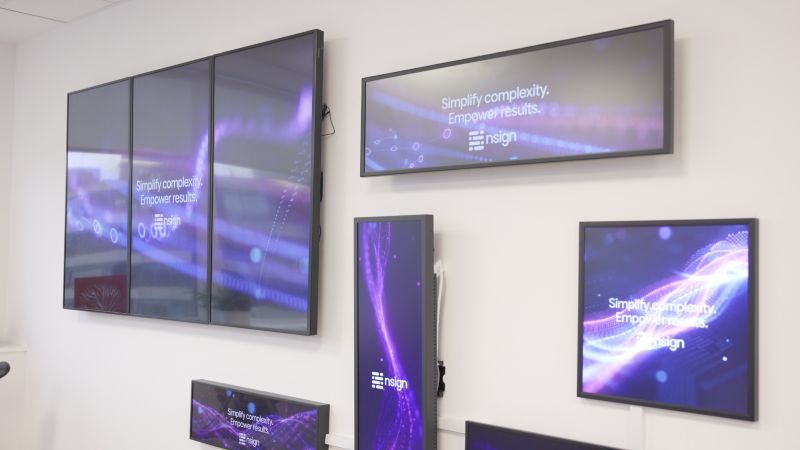
The showroom’s reception area runs displays from multiple manufacturers in several formats through the same platform. The setup includes a vertical screen built into a column, a display on a mobile stand and pedestal-mounted monitors.
The point is that organizations can operate networks with different types of hardware and keep using equipment they already own. That matters most for chains whose locations have different configurations.
Can One CMS Run a Campaign Across Different Screen Formats?
Yes, one demo area adapts a single message across seven display formats using one content management system and one publishing schedule. It shows how a campaign stays consistent across the different screen sizes and aspect ratios found in shop windows, digital menus and counters.
A large-format LED wall in the same space shows how the platform handles brand campaigns at entrances and in walkways.
How Does the Multi-Screen Synchronization Demo Work?
The multi-screen sync demo plays separate videos on three displays that start, progress and finish together to form one panoramic composition. The zone has its own dedicated area in the showroom.
What Does the Network Monitoring Area Show?
The network monitoring area shows a live dashboard with media player status and operational alerts. It also covers corporate communications use cases.
Visitors can see how applets combine video with web pages, news and data from business systems on one screen. That puts several information sources on a single display without separate players or feeds.
How Does the Video Analytics Display Work?
A freestanding display equipped with video analytics detects people in front of it and adapts its content to that audience. nsign points to opticians, pharmacies and specialty retailers as typical applications.
Those businesses often have limited space for communications. A single screen has to reach different audiences with different needs.
What Is Lift and Learn?
Lift and Learn is an interactive demo that triggers content on a nearby screen when a visitor picks up a product from a shelf. A sensor detects the lift and automatically starts the content.
That content might be a product demonstration, a features explanation or a comparison. It appears at the moment the customer shows interest in the item.
Does the Showroom Include Queue Management?
Yes, the showroom demonstrates a queue management system built into the same CMS. The display shows the current ticket number and estimated wait time alongside useful information or promotions.
One screen handles both customer service and marketing. Customers stay informed while they wait, and the business doesn’t need a separate queuing display.
Will the Showroom Change Over Time?
Yes, nsign designed the showroom as an evolving space, with content refreshed to match the marketing calendar and the capabilities on display. The company also plans to tailor the experience to individual visits over time.
Beyond customer demos, nsign uses the space for internal sessions and to share company launches and priorities with its team.
How Does nsign Describe Its Approach to Partner Hardware?
nsign describes the showroom as proof that its technology partners’ hardware integrates with its platform across very different store setups. The goal is to make varied location configurations simple to manage from one system.
“We have brought together displays in different formats, an LED wall, media players, cameras and sensors to show how our technology partners’ hardware and solutions integrate with nsign. Chains can have very different requirements from one location to another, and our aim is to make those different setups straightforward to manage through a single platform. We invite customers and partners to visit us and discover how they could apply these solutions to their own projects,” Fernández says.
What Does This Mean for Integrators?
The showroom reflects where multi-site signage projects are heading: hardware-agnostic platforms that manage mixed fleets, interactive triggers and audience data from one CMS. For integrators, that changes the conversation with chain clients from a hardware refresh to a platform decision.
It also opens more scope on each job. Sensors, cameras, queue management and synced retail media displays all add line items beyond the screens themselves.
When you spec or sell a signage platform to a multi-location client, start with an audit of the hardware already in their stores. Confirm the CMS supports those displays and players. Then ask which interactive features, such as analytics, Lift and Learn or queue management, the client wants to roll out, and plan sensor placement, camera privacy requirements and network capacity.