Editor’s Note: Here, Commercial Integrator’s editors highlight one of our 2026 Integration Award-winning projects. CTI earned top project honors in the Best Mission Critical category. Read on to learn why our judges deemed this project the most impressive mission-critical project of the year!
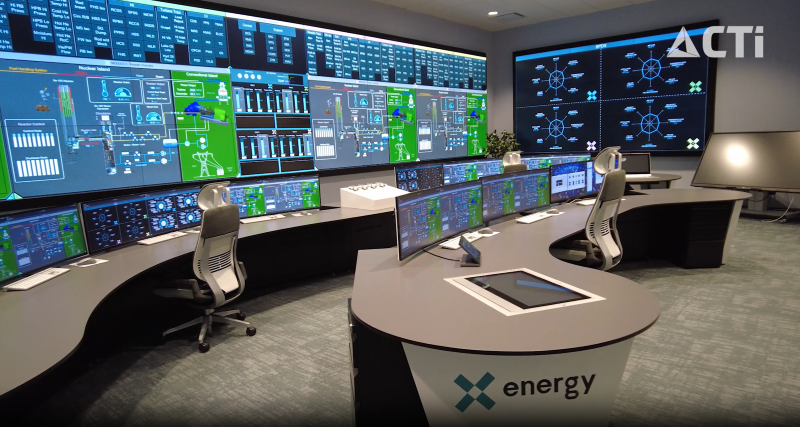
CTI has won Best Mission Critical Project for its work at X-energy, where it designed and installed the AV and recording backbone for a full-scale simulator of a nuclear plant’s control room. The simulator gives X-energy’s engineers and future operators a functional space to design, test and refine the screens, workflows and human-machine interfaces that will be used in plant operations.
For the integrator, the key challenge was tying multiple types of information into one coordinated system. Operator screens, camera views, the control panel, instructor direction and room audio all had to be recorded so they could be reviewed together.
Key Things to Know About This CTI Project
- The project: CTI provided AV across X-energy’s new facility, with the most mission-critical work centered on a simulator lab and instructor booth.
- The recording: Twelve operator screens, five camera streams and an audio feed are recorded in sync on a dedicated server.
- The audio: ceiling microphones, boundary microphones at operator positions and a push-to-talk gooseneck microphone at the instructor console.
- The playback: A separate replay client lets X-energy review sessions without interfering with ongoing recording.
- The reliability: The server has redundant power supplies, and UPS backup is designed to keep the system powered until building generators take over.
Why Does X-energy Need a Simulator?
The simulator gives X-energy a place to prototype a control room and train future operators. It physically mirrors what those operators will interact with in a nuclear-power-plant control room.

“You can’t operate a power plant without a control room,” says Megan Fickett, human factors engineer at X-energy.
According to CTI, this was not a typical AV project. The simulator had to support a training and development environment where consistency, visibility and reliability matter.
What Did CTI’s Work at X-energy Include?
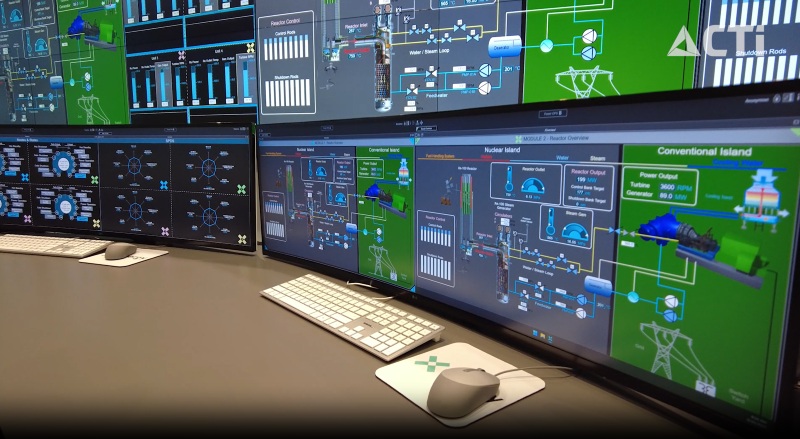
Photo courtesy of CTI.
CTI’s scope spanned multiple spaces across the facility: offices, conference rooms, a war room, a briefing room, digital-signage areas, classrooms and the simulator and instructor booth. Systems include collaboration displays, wireless presentation, videoconferencing, digital signage, ultrawide touch-enabled classroom displays, PTZ cameras, audio and room control.
According to Fickett, X-energy chose CTI for its knowledge, installation experience and ability to support the capabilities the project needed.
What Does the Simulator Recording System Capture?
The system captures 12 operator screens through Barco encoders, five camera streams and an audio feed from the Biamp DSP. Fixed cameras cover each operator position and the control panel, and a PTZ camera provides a view of the whole simulator room. A joystick camera controller lets users recall presets and adjust the view.
How Does CTI Capture Audio in the Simulator Lab?
CTI used three types of microphones. Ceiling microphones pick up ambient room audio, boundary microphones capture operators at their positions and a push-to-talk gooseneck microphone at the instructor console records instructor comments.
That gives X-energy a more complete record of each training or review session, not just what appeared on the screens.
How Did CTI Tie Project Sources Together?
CTI built a synchronized recording and playback environment that connects the room’s AV systems, networked cameras, audio DSP, encoders and server infrastructure into one workflow. To bring it together, CTI integrated SkySoft’s SkyRec recording system on a dedicated Dell PowerEdge server, which records synchronized audio and video for later review.
Playback runs through SkySoft’s Evidence Capture Replay client, so X-energy can review sessions without interfering with ongoing recording. According to CTI, that was a critical design point, since the simulator needed to support both active recording and later review without unnecessary operational friction.
How is the System Built for Reliability?
The server includes redundant power supplies, and CTI provided UPS backup designed to keep the system powered for several minutes during an outage until the building generators take over. According to CTI, a simulator meant for serious training, development and review needed to be dependable and ready when the team needed it.
What Does the Simulator Give X-energy?
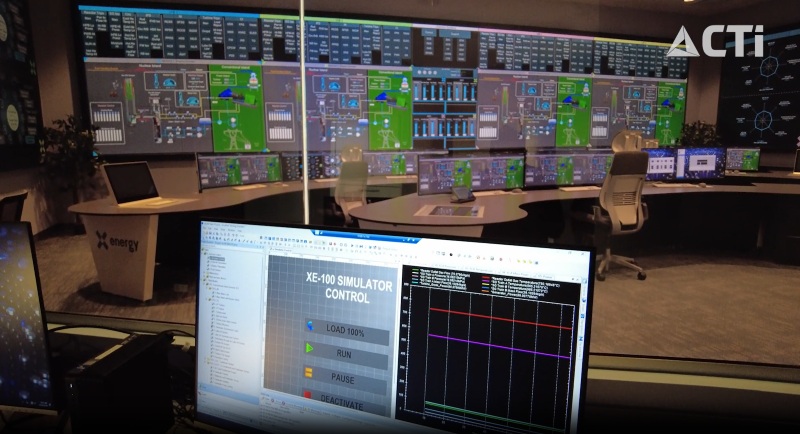
Photo courtesy of CTI.
The simulator, of course, gives X-energy highly elevated training capabilities. However, in addition, it gives X-energy a valuable tool for testing and design validation.
“By having the simulator here, [which] is so closely mirroring what we’re going to have in a real plant, this allows us to just immediately see what our work is going to look like in real life,” Fickett says.
What Does This CTI Project Teach Integrators?
The project shows the value of recording more than screens. By capturing operator screens, camera views and three types of microphone audio in sync, CTI gave X-energy a more complete record of each session.
In addition, it shows that a recording system for serious training benefits from built-in power protection. CTI paired redundant server power supplies with UPS backup designed to bridge an outage until building generators take over.