Spark Interactive, made possible by Legacy of Light Goldberg Institute for Holocaust Education, is a mobile experience that travels in a semi-truck that transforms into a fully functional exhibit space when it arrives.
Electrosonic collaborated with Unified Field and Yazdani Studios and provided audiovisual design, build and support services.
Spark Interactive combines digital artifacts, interactive storytelling and guided facilitation. It invites learners to explore how the Holocaust unfolded and why its lessons matter today.
How Spark Interactive Brings History Directly to Students
Spark Interactive aims to increase access to Holocaust education by bringing this history directly to students and teachers. Many public schools and communities lack the resources to offer that kind of experience on their own.

The program centers on the voices of Holocaust survivors who built their lives in San Diego. Through experiential storytelling, it fosters empathy, critical thinking and meaningful dialogue. Visitors connect lessons from the past to the challenges of today.
The content is grounded in historical accuracy, survivor testimonies and media literacy. That approach makes complex history easier for students to absorb. It also builds the skills they need to recognize misinformation.
Because the museum travels to neighborhoods and schools, it removes barriers that often limit engagement. Every young person, regardless of background, can learn from these stories and the human lessons they carry.
Selecting Electrosonic as Proven Museum Partner
Yazdani Studios selected Electrosonic based on the two firms’ successful history on traditional Holocaust museum installations.
Electrosonic also brought a track record of customized audiovisual integration built around the needs of each environment. For Spark Interactive, that meant technology that supports the visitor experience rather than distracting from it.
The result reshapes how students experience historical lessons. It turns abstract events into meaningful encounters that resonate with visitors.
Overcoming Challenges
Integrating a fully immersive, technology-rich experience into a mobile environment proved to be one of the most unique challenges of the project, says Electrosonic.
Each addition or modification required careful evaluation that considered both the spatial limitations and electrical demand placed on the system. Every new idea meant recalculating power consumption and ensuring that the generator could support the cumulative load without risk or failure.
At the same time, the team carefully managed weight distribution. The space’s ability to transform from a vehicle to a standing classroom and learning studio presented a complex challenge. The team measured and placed all of the equipment so that the vehicle remained balanced, safe and road ready.
This required close collaboration across engineering, design and integration teams, turning the vehicle itself into a carefully calibrated system where everything can function together seamlessly.
What are the Unique Features of Spark Interactive?
The integration of audiovisual technology plays a critical role in enabling the presentation of rich, layered content in a compact environment using dynamic visuals and sound to capture attention while supporting different learning styles. Importantly, this technology works to enhance interactivity between the educator and students, providing customizable, media-rich ways to ask and answer questions while engaging students in discussion.
The experience begins before a visitor steps inside. The side of the vehicle’s exterior is lined with a 2.5mm DETAILED Solutions LED wall display that presents media, catching viewers’ eye from a distance.
From the outside, the mobile museum looks like a semi-truck but upon arrival it transforms into a fully functional exhibit space. Each system is connected through an integrated control system, allowing the space to power up quickly and run smoothly no matter where it travels.
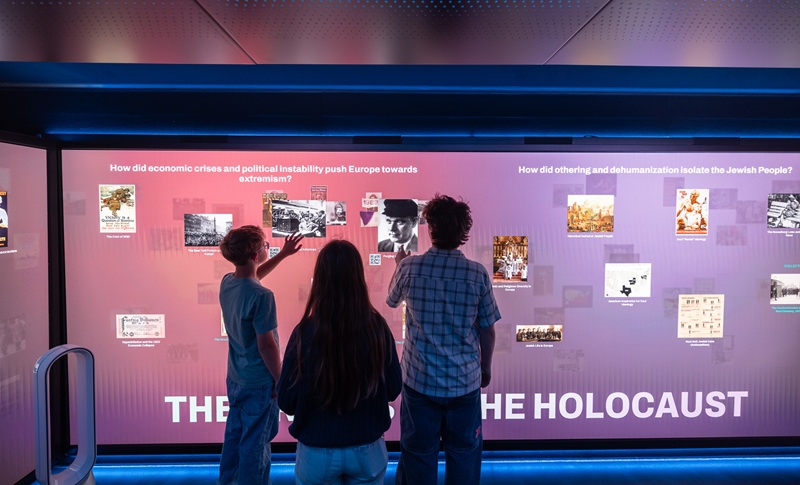
As visitors enter, they are greeted by a mix of video, audio and hands-on interactions. There are three 6.64-foot LED screens displaying digital media introducing the story of the Holocaust and laying the groundwork for the rest of the space.
Visitors then walk into the main space where they are met with three more LED screens with interactive touchscreens and over 80 smart tablets letting visitors explore stories and information.
Technology and Storytelling Work Hand in Hand
As guests move through the space, the educators use the platform, bringing technology together to create a smooth and engaging experience that teaches visitors about the realities of the Holocaust. The audio from speakers is balanced for the small space so it’s clear but not overwhelming, working to tell the audience stories from the past and its importance to the future. [EW1.1] LED displays add visuals to the information bringing names to faces and drawing people into the story.
Interactive technology further enhances the experience by allowing visitors to interact directly with the content, offering new ways to explore and understand each detail. Together, these systems create a cohesive environment where technology and storytelling work hand in hand.
The result is a thoughtfully designed mobile experience that encourages reflection and discussion, making complex history more accessible and engaging for every visitor.
Creating an Impactful Storytelling Experience
Erica Whinston of the Jewish Federation of San Diego remarks that the mobility is central to the program’s mission.
“The experience draws people in and its mobility is essential to our mission to deliver and increase access to innovative Holocaust education,” says Whinston. “Now we can share history directly with communities and students that we couldn’t easily reach before.”
Speaking on the integration itself, Whinston adds, “The seamless integration of visuals, audio and interactivity has transformed how we share these stories, making them more engaging and impactful for every visitor. The technology doesn’t replace history, it strengthens it while creating an immersive experience that resonates with the audience.”
Frequently Asked Questions
- Who Won Best K-12 Project?
- Electrosonic won the 2026 Integration Award for Best K-12 Project for Spark Interactive.
- What Is Spark Interactive?
- Spark Interactive is an immersive mobile museum that brings Holocaust education directly to schools and communities. It travels in a semi-truck that transforms into a fully functional exhibit space.
- What AV Technology Does Spark Interactive Use?
- The experience uses a 2.5mm Detailed Solutions LED wall on the exterior, three 6.64-foot LED screens at the entry, three LED screens with interactive touchscreens in the main space and more than 80 smart tablets. An integrated control system connects every component.